


Water becomes a growing concern in Barind region
Published:
৮ মে ২০২৬, ১০:৪৩
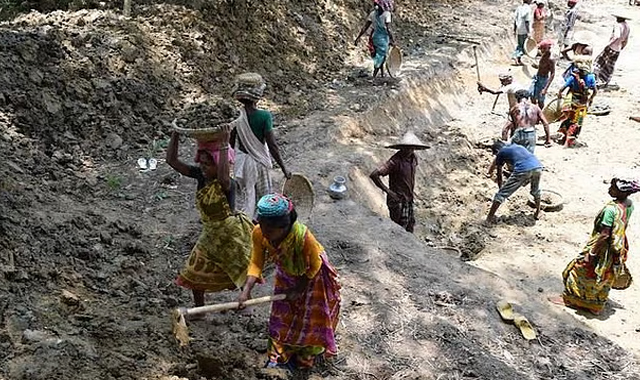
Water has now become the biggest concern in many villages of the Barind region in Rajshahi, Naogaon and Chapainawabganj. The ponds whose water people once used for daily activities are now abandoned. Water no longer comes up from the tube wells in household yards. The deep tube wells that once irrigated acres of farmland now sometimes produce water and sometimes do not. As a result, many areas are facing an acute shortage of drinking water.
Researchers said indiscriminate extraction of groundwater is destroying underground aquifers. As a result, even when there is sufficient rainfall, groundwater is not being replenished. The water crisis is causing the collapse of irrigation systems, increasing the cost of rice cultivation and leaving vast tracts of land uncultivated. People are even struggling to collect drinking water.
In such a situation, the government on 25 August last year declared 1,469 mouzas under 47 unions in 25 upazilas of Rajshahi, Chapainawabganj and Naogaon districts as “areas with extremely high water scarcity.” In addition, 884 mouzas were declared “high water-scarcity areas” and 1,240 mouzas were declared areas with moderate water scarcity.
Following the declaration, a gazette was issued in January imposing strict restrictions on groundwater use. The gazette imposed 11 restrictions, including a ban on installing new tube wells and extracting groundwater for any purpose other than drinking water in the water-stressed areas. However, in reality, the restrictions are not being followed. As a result, the crisis is worsening steadily.
Uchhadanga village in Tanore upazila of Rajshahi is one of the “extremely high water-scarcity” areas. Elderly resident Tajmul Haque, 84, describing his suffering, said, “Earlier we drank pond water. The ponds got ruined. The government installed tube wells. Those did not work. They say there is no water even 1,400 feet below ground. An organisation dug the soil and found a little water in three places. Motors have been installed there. Now the villagers are drinking water from those three points. If this water runs out, we will again have to drink pond water. Otherwise, we will have to leave the area.”
People concerned are speaking of alternative initiatives, including increasing the use of surface water, to deal with the situation. Professor Chowdhury Sarwar Jahan of the Department of Geology and Mining at University of Rajshahi told Prothom Alo that alternative water sources must be arranged quickly on a priority basis. Otherwise, a disastrous situation over water will emerge.
Water-stressed areas in 153 unions
A water-stressed area refers to a region where there is insufficient water to meet the demand for safe drinking water. Climate change and unplanned use of groundwater are worsening the situation. Under the Bangladesh Water Act 2013, the government identifies such areas and adopts strict policies regarding their management, use and conservation.
The Water Resources Planning Organization (WARPO) has identified 1,469 mouzas under 47 unions in 25 upazilas of Rajshahi, Chapainawabganj and Naogaon as “areas with extremely high water scarcity,” 884 mouzas under 40 unions as “high water-scarcity areas,” and 1,240 mouzas under 66 unions as “areas with moderate water scarcity.” A gazette regarding the matter was published on 22 January.
Following this, the areas were declared “water-stressed” for the next 10 years. Instructions were issued to stop groundwater extraction in these areas for any purpose other than drinking water within the next two years.
According to the Bangladesh Bureau of Statistics, the total area declared water-stressed covers 2,787 square kilometres, where over 2.1 million people are suffering from water scarcity.
The country’s groundwater situation is very alarming, especially in industrial regions and the Barind area, where underground water has been extracted for years without any acceptable survey, said Syeda Rizwana Hasan, who was the adviser to the Ministry of Water Resources in the former interim government. She told Prothom Alo, “We were compelled to declare the Barind area a water-stressed zone. At the same time, we prepared a preliminary action plan to ensure groundwater recharge in the area. I hope the government will quickly begin implementing the plan.”
She believes that if this is done, agriculture in the Barind region will change, and people will move away from cultivating crops that require large amounts of water and instead begin farming crops dependent on less water.
Rizwana Hasan warned that industrial-rich Gazipur is facing conditions as severe as those in Barind. Controlling the use of groundwater in industries is extremely urgent. She said if the policy draft finalised by the interim government is not approved and implemented quickly, the country will face a major disaster in the future.
11 restrictions in water-stressed areas
According to the Water Act, no new tube wells may be installed and no groundwater may be extracted in water-stressed areas for purposes other than drinking water. While continuing the supply of drinking water through existing tube wells, steps must be taken to diversify crops used in irrigation and gradually stop groundwater extraction within two years. The relevant authorities must take measures to encourage farmers to reduce groundwater extraction.
The minimum safe extraction limit of groundwater in any area may be determined. Groundwater-dependent industries or institutions cannot be established.
The classification of canals, wetlands, ponds, rivers or any other water body cannot be changed, and water bodies must remain open for public use.
Leasing of publicly usable government-owned water bodies and fisheries must be discouraged, and all water from any reservoir cannot be extracted. Compliance with these 11 restrictions is mandatory. Violation of the restrictions will be considered a punishable offence.
No one complies with the restrictions
According to the rules, no consumer with a rural electricity connection is allowed to use groundwater for purposes other than drinking water. A recent visit to the area found that no one is complying with the restriction. Many people are using residential electricity connections to run submersible pumps and extract groundwater for irrigation. The Rural Electrification Board is only imposing fines.
The water level is lowest in Uchhadanga village of Narayanpur mouza in Tanore, where irrigation for paddy fields is openly being carried out using residential electricity connections. On 14 April, while walking beside pipelines, it was seen that some people had punctured mud walls to extend pipes outside and irrigate fields.
When called out, they were initially too frightened to come out. Eventually, one person emerged and said, “The land is lying barren—how will we survive? That is why we are doing this to save our lives.”
At Airar Mor in Mundumala municipality area of Tanore, irrigation is being carried out on around 100 bighas of Boro paddy fields from a privately owned deep tube well. Locals said the irrigation system was operating using an electricity connection taken from a rice mill meter.
Looking through the gap in the closed door of the so-called rice mill, abandoned parts of the rice mill could be seen lying inside. Irrigation pipes and other equipment were also visible in the room. The owner, businessman Zahurul Islam, is from Chakbadhair village under Badhair union in Tanore. Asked about the matter, Zahurul said, “Three years ago, the UNO office gave me permission to install this tube well.”
Adverse impact of groundwater extraction
The Bangladesh Agricultural Development Corporation (BADC) first began using groundwater for irrigation in Rajshahi, Naogaon and Chapainawabganj during 1985–86. Since 1993, the Barind Multipurpose Development Authority (BMDA) has been carrying out the work.
The government had instructed that a maximum of 11,400 deep tube wells could be installed for irrigation in the water-stressed areas of these three districts. But ignoring the directive, 62,000 shallow tube wells and 4,000 deep tube wells have been installed.
These privately installed tube wells have a combined capacity equal to 28,000 deep tube wells. Had the directives been followed, groundwater levels would have returned to their previous condition every year after the monsoon.
Sources at BMDA said indiscriminate extraction of groundwater has lowered water levels so drastically that in some places the underground aquifer layers have died. The sand that used to hold water in these layers has turned into dust. Instead of sand, there is now only mud. No matter how much it rains, water no longer accumulates there.
Statistics show that BMDA has 3,077 deep tube wells in the areas classified as extremely high water-scarcity zones across the three districts. The highest number is in Nachole of Chapainawabganj, where BMDA has 502 tube wells.
According to statistics from the Water Development Board, in some parts of Nachole the groundwater level fell from 29.09 metres to 31.04 metres between January 2023 and January 2025. It was never replenished afterward. The same fate has occurred across other extremely high water-scarcity areas.
Crisis even for drinking water
A severe shortage of drinking water has already begun in the “extremely high water-scarcity” areas.
In the Kaloir indigenous neighbourhood under Kasba union of Nachole upazila, there are 14 indigenous households, 20 Hindu households and 30 Muslim households. There is no arrangement for drinking water there. Non-government organisation Dascoh Foundation has provided them with a submersible pump.
There, 60-year-old Malati Bala said, “There is terrible suffering for water here. I walked from very far away just to get one container of water.”
Assistant teacher Md Majidul Islam of BIAM Model School and College in Nachole said people in the area used to drink pond water 30 years ago. Due to wrong government policies, ponds and wetlands are now on the verge of destruction. Now a desperate struggle for drinking water has begun.
Residents of Uchhadanga village in Tanore are also in trouble. The village had three deep tube wells. All are now out of order. Water no longer rises. Dascoh Foundation drilled 1,400 feet deep and found only mud—no water anywhere. Now, after locating pocket aquifers, they have installed three tube wells. Villagers are drinking water from them. The total electricity bill is divided among the population and paid collectively.
Yubal Marandi of the village said 90 families drink water from their pump. Each person pays Tk 35 to Tk 40 per month. In March, he had to pay Tk 105.
A recent visit to Lakshmipur, Sheetaldanga and Harbhanga villages under Chhaor union of Porsha upazila in Naogaon, as well as Ganpur, Baldahar and Ukunpur villages under Hajinagar union of Niamatpur upazila, found that for the past 6 to 7 years no water has come out of hand-operated tube wells in these villages. Drinking water has to be collected from BMDA-installed deep tube wells. In some places, people have to travel 300 to 500 metres to collect drinking water from deep tube wells.
Beside a rural road in South Lakshmipur village of Chhaor union, water lifted by a submersible pump was being stored in a tank. Sumita Rani was seen taking water from there. Asked where she was taking the water, she pointed to a neighbourhood nearly 200 metres away and said, “I’m going to that neighbourhood. We do not get drinking water in our area. So every day we bring water from this tap and drink it. Carrying water from so far away is difficult. But there is nothing else we can do.”
Schoolteacher Rezaul Islam of Harbhanga village said almost every well-off family in the village has installed submersible pumps at home for drinking water, bathing and household work. But during the Bengali months of Chaitra and Boishakh, these pumps stop extracting water. Sometimes the pumps break down. Then everyone brings water from BMDA deep tube wells installed in the fields. During Chaitra and Boishakh, water in almost all village ponds dries up. There is not even enough water for bathing or washing dishes.
Water levels keep falling
Sundarpur mouza in Godagari is an area with extremely high water scarcity. At a BMDA deep tube well there, it was seen that only one-fourth of the water was rising through a 4-inch pipe. At times, even less water was coming up.
The tube well operator, Sattar Ali, said, “For the last three years, water rises in this deep tube well and then stops again. There is no guarantee. Now we are operating it at risk. Boro paddy has been cultivated on 40 to 50 bighas of land under this tube well.
Now people have to eat to survive, you understand. Water layer is going down day by day. We are lifting water only because Allah is lifting it. Within two to five years, all the deep tube wells will become useless.”
Farmer Sahanara Begum, 45, of Sundarpur village cultivated Boro paddy under this tube well. She took reporters to her paddy field. It was seen that the soil had started cracking. Without irrigation now, the land would dry out. Sahanara Begum said, “It takes four hours to irrigate a bigha of land. The cost of irrigation alone has risen to as much as Tk 5,200 for cultivating a bigha of Boro paddy.”
Saidul Islam, who has operated deep tube wells for a long time in Shialdanga village of Porsha upazila in Naogaon, said water was first found at a depth of 90 feet from the tube well in 1992. After 10 to 12 years, water no longer rose. Then drilling was done again and water was found at 110 feet. Four years later, another round of drilling found water at 120 feet. He said the way the water level is falling, it seems that after some days no water will rise anymore.
Abdul Jabbar Mondal of Lakshmipur village under Chhaor union of Porsha said, “There are three deep tube wells in our village. Even 10 years ago, these deep tube wells could irrigate 150 to 180 bighas of land for paddy cultivation. Now only 90 to 110 bighas can be cultivated. During droughts, the water pressure is no longer like before. BMDA has also imposed limits on the number of hours deep tube wells can run during the irrigation season. They say deep tube wells cannot operate more than 980 hours in one season.”
What BMDA says
BMDA Additional Chief Engineer Abul Kashem told Prothom Alo that the government’s directive allowed a maximum of 11,400 tube wells, of which 8,400 belonged to BMDA. Altogether, privately owned pumps equivalent to 28,000 tube wells are operating. He said BMDA extracts only 27 per cent of the water, while the remaining water is extracted by privately owned pumps. “No one is controlling these,” he added.
Abul Kashem said BMDA is currently using 22 per cent surface water for irrigation. This will increase to 30 per cent by 2030 and 50 per cent by 2050. For this purpose, one-third of a Tk 5.48 billion project has already been completed. Within the next two years, the project will provide irrigation to 10,250 hectares of land. In addition, two more projects are awaiting approval.
He also said there are 5,553 government-owned ponds and water bodies in the Barind region. These are being leased out by the upazila administration. If these are handed over to BMDA, they could be opened for public use, he said.
Regarding ponds, Rajshahi Divisional Commissioner ANM Bazlur Rashid told Prothom Alo that not all government-owned ponds have been leased out. Some are being re-excavated for use as reservoirs. A coordination is necessary between the Ministry of Water Resources and the Ministry of Land to open all of them for public use.
Fields look like deserts
Vast tracts of land in Pakri and Mohanpur of Godagari upazila, and in Mundumala municipality area and Badhair union of Tanore upazila, have now turned into desert-like fields. There are no people in the fields. The land lies barren and empty.
There is a deep tube well in Narayanpur mouza of Pakri union, but no Boro paddy could be cultivated this year. The transplanted seedlings are still lying in the seedbed. One or two farmers are trying to cultivate pointed gourd. A guava orchard can be seen some distance away. All the remaining land lies uncultivated.
Local Benjamin Kisku was seen on the road at Bargachhi Kanupada of Pakri union. He said his brother Julian Kisku cultivated paddy on three bighas of land last year. This year they could not cultivate Boro due to water shortages. Instead, they cultivated Chaitali crops. After that, their land will remain fallow until Aman paddy transplantation. If there is good rainfall during the monsoon, then Aman cultivation may succeed.
The Chandlai fields under Mohanpur union of Godagari upazila are lying in the same condition. Only a shepherd with a few goats could be seen there.

Comment: