


Is the Distance Between Humans and the Environment Increasing?
Published:
১৩ জুন ২০২৬, ১৬:০১
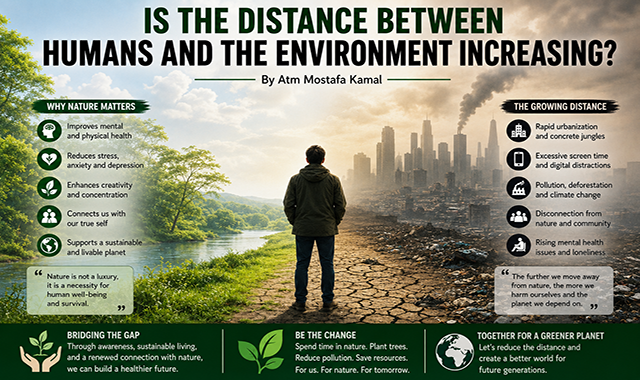
Have you ever wondered why most people prefer hotel rooms with balconies or scenic views? Why do patients who can see natural landscapes from their hospital beds tend to recover faster than others? Or why, when anxiety and depression overwhelm us, we long to spend time in nature to find clarity?
Human beings have shared a deep connection with nature since the beginning of creation. The elements of the natural environment significantly influence our thoughts and emotions. Walking through a green forest or strolling along a sunny beach can awaken a deep sense of peace and happiness—this is not merely spiritual, but scientifically grounded. The fresh air and captivating beauty of nature open our minds and calm our restless hearts. A specialized branch of psychology, known as environmental psychology, has advanced significantly in explaining these phenomena.
In his famous book Last Child in the Woods, author Richard Louv introduced the concept of “Nature-Deficit Disorder.” According to Louv, this condition arises when humans lose their connection with nature. Being close to nature improves physical, mental, and spiritual well-being. It makes us feel alive from within, and despite the rapid growth of urbanization, technology, and social media, we should not compromise this essential connection.
In 1953, the American Psychiatric Association, in collaboration with the American Institute of Architects, established an architectural research project aimed at improving mental hospital environments in North America. Experts from psychiatry, behavioral science, planning, and design came together to explore how elements such as light, color, privacy, and social interaction spaces influence mental health. Their work extended beyond institutional walls and contributed to the development of environmental psychology, helping prevent mental illness and promote mental well-being during urban crises.
Environmental Psychology
Environmental psychology is a specialized field that seeks to establish the relationship between human behavior, experience, and the surrounding environment. Interest in this field has been growing globally over time.
The concept dates back to 1911, when Polish psychologist Willy Hellpach first introduced ideas about environmental psychology, explaining the connection between humans and environmental factors. Although significant research began in the 1960s, the field is still evolving due to its interdisciplinary complexity.
Egon Brunswik and Kurt Lewin are often considered pioneers of environmental psychology. While their direct contributions were limited, their ideas about the relationship between physical environment, human perception, and behavior laid the foundation for further development. Brunswik emphasized that physical environments influence psychological processes beyond our awareness, while Lewin focused more on social and interpersonal influences. Their students, including Barker and Bronfenbrenner, later advanced the field significantly.
Initially, research progressed slowly and was often referred to as “architectural psychology,” focusing on how different environments affect human perception and behavior. However, in the late 1960s, growing awareness of environmental issues accelerated the field’s development, leading to studies on sustainable environments and behavior change.
Recent research has further strengthened this field. Indian psychiatrist Madhulina Roy Chowdhury highlighted several studies:
-
Psychologists from the USA, UK, China, and Australia found that moderate climates (22–24°C) positively influence personality traits such as openness, extroversion, and agreeableness.
-
A 2017 study by Ryan Lumber, Miles Richardson, and David Sheffield showed that closeness to nature triggers positive emotions. Activities like hiking, gardening, or birdwatching strengthen mental well-being.
-
Professor Helen Lockhart suggested that humans share a spiritual connection with nature, which is now threatened by socio-environmental crises.
Since the beginning of the 21st century, it has become clear that climate change, pollution, and deforestation are major threats to global health, economic stability, food security, and clean water supply. Experts believe that human behavior is at the root of these problems.
Environmental psychology offers one of the most effective ways to address these challenges by understanding and transforming human behavior. It has the potential to improve both environmental sustainability and human quality of life. With continued research and growing awareness, this field may help bridge the widening gap between humans and nature, paving the way for a more livable planet for future generations.
Author: Special Correspondent, Daily Voice of Asia

Comment: