
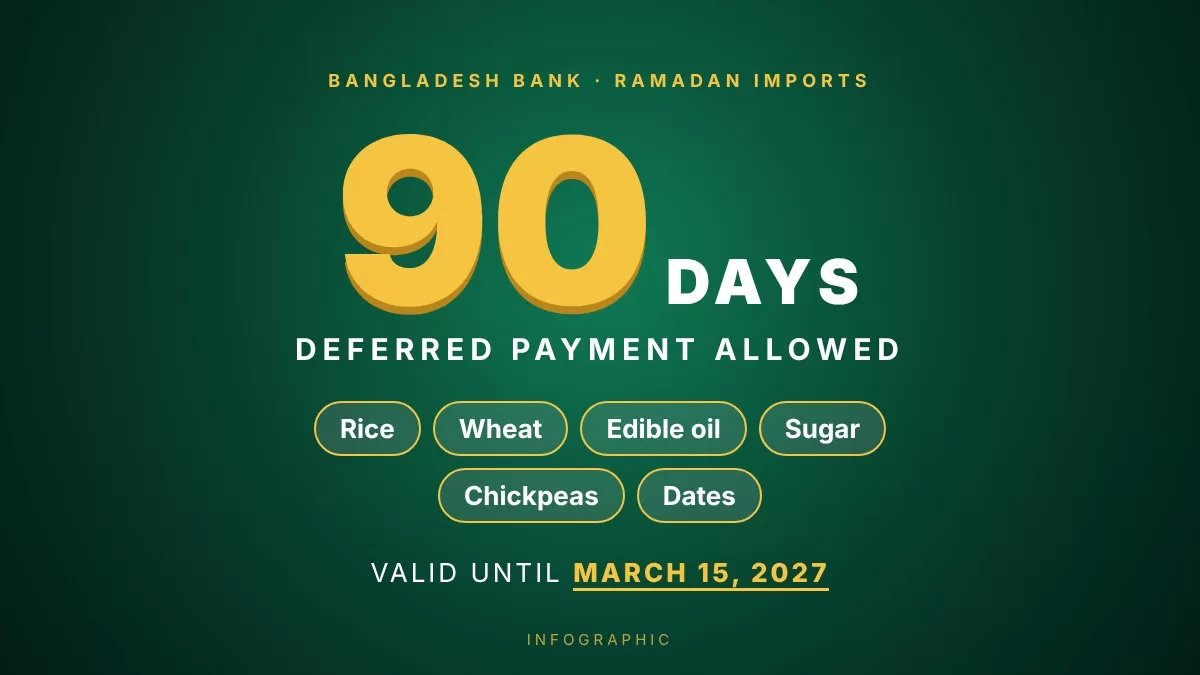
Bangladesh Bank has allowed imports of essential food items on deferred payment terms of up to 90 days ahead of the holy month of Ramadan, under buyer's or supplier's credit arrangements.
The central bank issued a circular on Wednesday permitting imports of the specified items on usance terms of up to 90 days. The eligible commodities include rice, wheat, flour, onions, pulses, soybean oil, palm oil, sugar, chickpeas, peas, spices and dates.
The facility aims to ensure an uninterrupted supply of essential commodities and to help keep domestic market prices stable during Ramadan. It will remain in effect until March 15, 2027. All authorized dealer banks have been told to inform their importing clients about the revised payment arrangement.
All other existing foreign exchange regulations and guidelines governing import transactions will remain unchanged.
The move comes ahead of Ramadan, when domestic demand for essential food items, particularly edible oil, sugar, chickpeas, onions and dates, typically rises. Allowing deferred payment is expected to ease importers' immediate burden of paying in foreign currency and to help them import on time.
In a separate circular, Bangladesh Bank clarified foreign exchange rules on payment commitments issued by local agents on behalf of foreign airlines and shipping companies. Under Section 18-B of the Foreign Exchange Regulation Act, 1947, authorized dealer banks can issue payment commitments abroad on behalf of local agents of foreign airlines or shipping companies that have no independent business operations in Bangladesh.
Where a foreign airline or shipping company has registered business operations in Bangladesh under that provision, payment commitments must be issued directly in favor of its local operations in taka. Banks cannot issue such commitments abroad in those cases.
An earlier circular governs the issuance of collateral instruments by authorized dealer banks, including standby letters of credit, bank guarantees and other payment commitments, on behalf of local agent-customers against surplus earnings payable abroad. The latest instruction clarifies when such guarantees and payment commitments can be issued overseas and when they must instead be issued locally in taka.
Bangladesh Bank has told all authorized dealer banks to immediately inform their clients and agents about the clarified requirements to ensure compliance with foreign exchange regulations.