
Azerbaijan plans to launch large-scale production of blue and green hydrogen to decarbonize sectors of its economy that are hard to electrify, according to the country's long-term low-carbon development strategy. The document gives hydrogen a central role in moving heavy industry and the energy sector to a carbon-free model of operation.
Because the country already has a developed gas transport network, the strategy says the most cost-effective approach at the start is blue hydrogen produced through steam methane reforming. The process would use carbon capture, utilization and storage technology, which can capture up to 85 percent of the CO2 emissions generated. In the future, excess output from renewable sources is to be used to produce green hydrogen by electrolysis, for use by energy-intensive domestic industries and for export.
The power sector accounted for about 21 percent of Azerbaijan's total emissions in 2022, or 14.4 million tons of CO2 equivalent, and is meant to become the foundation of broad electrification of the economy. The technical potential of renewable energy in the country exceeds 135 GW on land and 157 GW in the Caspian Sea. The economically viable potential is estimated at 27 GW, including 23 GW of solar, 3 GW of wind, 520 MW of small hydropower on mountain rivers and 380 MW of bioenergy.
The strategy also calls for strengthening high-voltage power lines, building new substations and adding digital control systems, including SCADA, ADMS and GIS. These steps are expected to cut technical losses in distribution networks by 1 to 2 percent. To balance the intermittent output of renewables, long-duration energy storage systems are being introduced. AzerEnerji has already commissioned battery storage facilities with a total capacity of 250 MW.
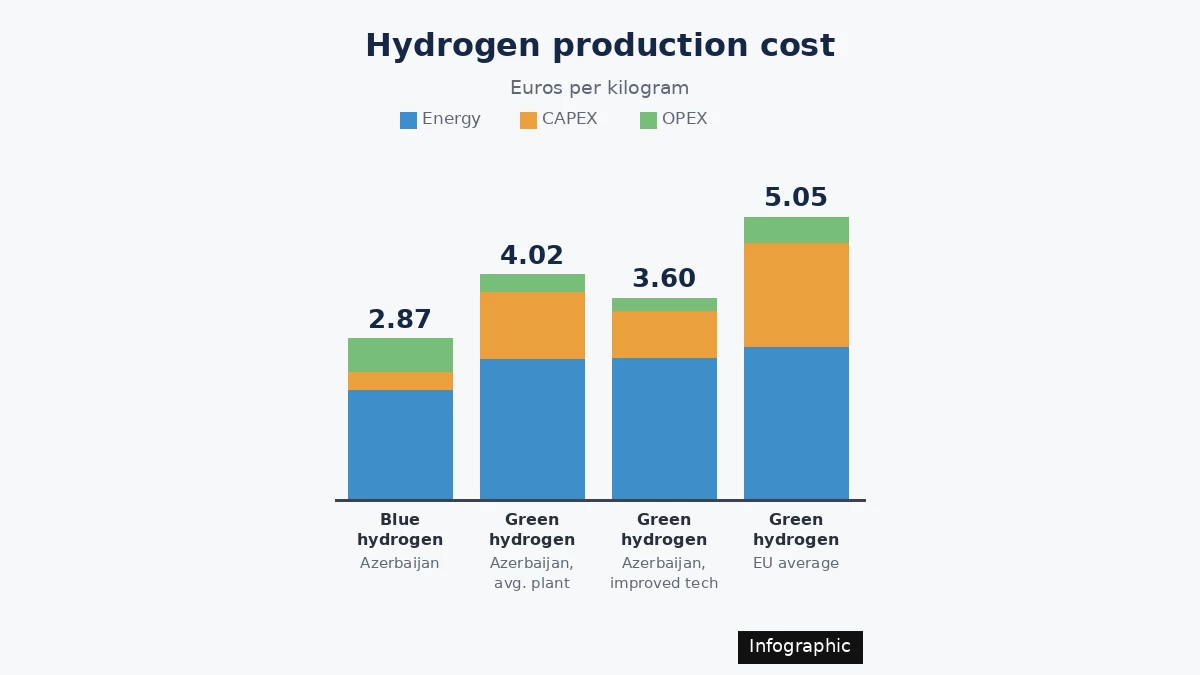
Under the National Hydrogen Strategy, prepared by the Ministry of Energy with help from the European Bank for Reconstruction and Development, blue hydrogen would be the most economically attractive type if carbon capture and storage proves viable. Its cost would be 2.87 euros per kilogram, made up of 1.98 euros for energy, 0.31 euros for capital expenditure and 0.59 euros for operating expenses.
Green hydrogen from renewable sources costs more. At an average-scale facility it would cost 4.02 euros per kilogram, including 2.52 euros for energy, 1.2 euros for capital expenditure and 0.3 euros for operating costs. Technological improvements could bring that down to 3.6 euros per kilogram. By comparison, the average cost of green hydrogen in European Union countries is 5.05 euros per kilogram, of which 2.74 euros is energy, 1.85 euros is capital expenditure and 0.46 euros is operating cost.
Source: Report.az