
The Green Energy Corridor Power Company, known as GECO, has submitted an application to the European Commission seeking recognition of the Green Energy Corridor project as a Project of Mutual Interest under the EU's Trans-European Networks for Energy, or TEN-E, regulation.
The project would open a new route for renewable electricity from the Caspian region to European markets. It would connect Azerbaijan, Georgia, Romania and Hungary through a high-voltage direct current submarine cable across the Black Sea, along with supporting onshore infrastructure.
According to GECO, the status would recognize the project's strategic importance for the EU and its partners. It would also strengthen access to EU support, streamline permitting and reinforce investor confidence as the project moves through its development phase. The company said the application was the result of close cooperation among its shareholders, AzerEnerji, the Georgian State Electrosystem, Transelectrica and MVM, and thanked the governments of the four countries, the European Commission and its technical partners for their support. It said it looks forward to the next stage of the evaluation process.
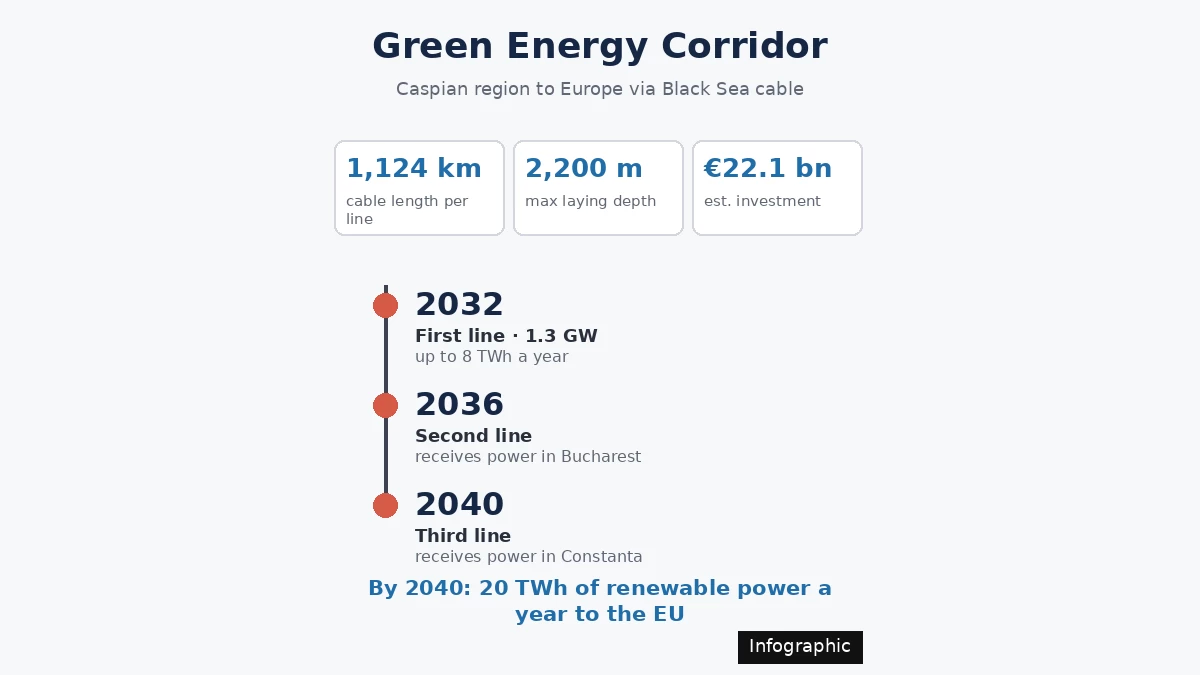
Each line of the submarine cable will be about 1,124 kilometers long and will be laid at depths of up to 2,200 meters. The route will run from Baku through Georgia, with landfall in the Anaklia and Poti areas and passage through Tbilisi and Tskaltubo, then on to Romania via Constanta and Bucharest, and finally to a hub in Albertirsa, Hungary.
The project will be carried out in stages. The first line, with a capacity of 1.3 GW, is planned to start in 2032 and will allow exports of up to 8 TWh of renewable electricity a year. The second line, which will deliver electricity to Bucharest, is due to begin operating in 2036, and the third, delivering to Constanta, in 2040.
By 2040, annual deliveries of renewable energy from the Caspian region to the European Union are expected to reach 20 TWh. Total investment in the project is estimated at about 22.1 billion euros, of which 14.3 billion euros will be needed for transmission infrastructure.
Source: Report.az